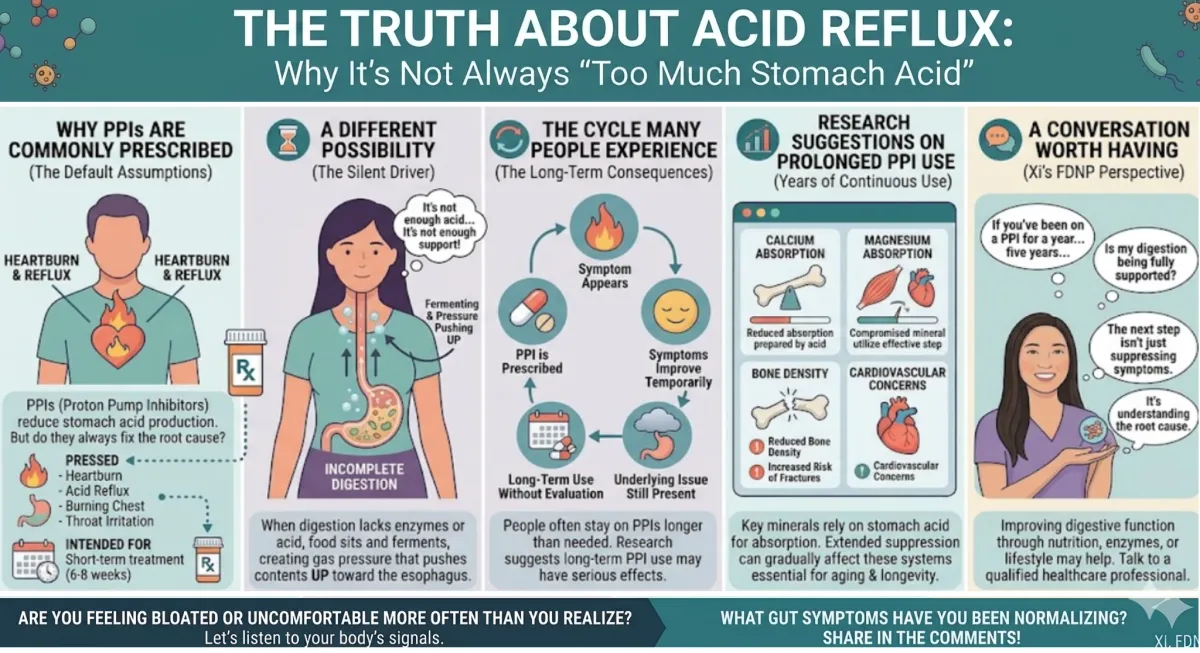
The Truth About Acid Reflux Most People Aren’t Told
The Truth About Acid Reflux: Why It’s Not Always “Too Much Stomach Acid”
If you’ve ever been told you have too much stomach acid and were prescribed a medication like a proton pump inhibitor (PPI), there’s something important you should understand.
For many people experiencing reflux or heartburn, the default explanation is simple: there must be too much acid in the stomach.
But what if that assumption isn’t always correct?
In many cases, reflux symptoms may actually be linked to the opposite problem.
Sometimes, it’s not too much stomach acid—it’s not enough digestive support.
Why PPIs Are Commonly Prescribed
Proton pump inhibitors (PPIs) are medications designed to reduce stomach acid production.
They’re commonly prescribed when someone experiences symptoms such as:
Heartburn
Acid reflux
Burning in the chest or throat
Indigestion
The idea behind prescribing them is straightforward: if stomach acid is causing irritation, reducing acid levels should relieve symptoms.
And in many cases, people do feel better—at least initially.
But that doesn’t always mean the underlying issue has been addressed.
A Different Possibility: Incomplete Digestion
In some situations, reflux symptoms can develop not from excessive stomach acid, but from poor digestion.
When the stomach doesn’t produce enough digestive enzymes or stomach acid, food may sit in the stomach longer than it should.
Instead of moving efficiently through the digestive process, that food begins to ferment.
As fermentation occurs, gas builds up.
That gas increases pressure inside the stomach, and the pressure can push stomach contents upward toward the esophagus.
This upward pressure can create the burning sensation and reflux symptoms many people associate with excess acid.
In other words, the symptom may look the same, but the root cause can be very different.
The Cycle Many People Experience
This is where a pattern often develops.
Someone experiences reflux.
A PPI is prescribed.
Symptoms improve temporarily because acid levels are suppressed.
But the underlying digestive issue may still be present.
As a result, people often remain on these medications much longer than originally intended—sometimes for years.
Why Long-Term PPI Use Deserves Attention
Stomach acid plays a critical role in digestion.
It’s not just there to break down food—it also helps the body absorb key nutrients and minerals.
Two of the most important minerals that depend on adequate stomach acid for proper absorption are:
Calcium
Magnesium
When stomach acid is significantly reduced for extended periods, these minerals may not be absorbed as efficiently.
In simple terms, stomach acid helps prepare these minerals so the body can use them effectively.
Without that step, they may pass through the digestive system without being fully utilized.
Over time, this can matter.
What Research Has Suggested
Research has explored the potential effects of long-term PPI use—meaning years of continuous use, not the short-term treatment these medications were originally designed for.
Some studies have found associations between prolonged PPI use and:
Reduced bone density
Increased risk of fractures
Cardiovascular concerns
This doesn’t mean PPIs are inherently harmful.
They can be incredibly valuable medications when used appropriately.
But like many medications, they were originally intended for short-term therapeutic use, not necessarily long-term management without ongoing evaluation.
Why This Matters for Long-Term Health
Minerals like calcium and magnesium are essential for many systems in the body.
They play critical roles in:
Bone strength
Muscle function
Heart rhythm
Blood vessel health
These systems are also central to healthy aging and longevity.
When mineral absorption is compromised over long periods, it can gradually affect these areas of health.
That’s why it’s important to look beyond symptom relief and consider the bigger picture.
What PPIs Were Originally Designed For
Proton pump inhibitors were initially intended for short-term use, typically around 6 to 8 weeks.
Their purpose was to allow the stomach or esophagus time to heal in situations like:
Gastric irritation
Ulcers
Severe reflux episodes
After that healing period, the next step should be to reassess digestive health and underlying causes.
But for many people, that reassessment never happens.
A Question Worth Asking
If you’ve been taking a PPI for a year… two years… five years… or longer, it may be worth asking an important question:
Is my digestion being fully supported?
For some people, improving digestive function—through nutrition, enzyme support, or lifestyle adjustments—may help address the root issue.
If you’ve been on a proton pump inhibitor long-term and still don’t feel your best, it may be worth having a conversation with your doctor about your digestive health to understand why those symptoms began in the first place.